Albert Einstein Inventions List | By phillip vales
What did Albert Einstein Invent? The celebrated German Jewish theoretical physicist Albert Einstein made both practical and the
oretical inventions. Whilst most people believe that Dr. Einstein being a patent clerk would indicate that he was a great practical inventor, on the contrary, he had only a couple of inventions patented in the US and in foreign countries. In fact, his greatest contributions to science were inventions that took the form of theoretical mathematical understandings of physical phenomena. Since his untimely death in 1955, many of these would be later confirmed by close experimental and observational data over the decades.

Albert Einstein Inventions
Einstein’s patented inventions in the United State come to a sum total of two disparate concepts: one dealing with a refrigerator and one dealing with a camera. As a patent practitioner (phillip vales) myself, I was a bit surprised by this. I recently did a search on the USPTO.gov and found these two patents shown below.
1- Refrigeration Patent US patent No. 1781541 Einstein
2- Camera Patent US patent No. 2058562 Einstein and Bucky
The other patents that Einstein filed were mostly variants of a chilling idea in combination with Leo Szilard although he also filed another patent with Goldschmidt as shown here. For those that don’t know a Kaeltemaschine is a chilling or cooling device.
| Switzerland | |||
| 1930 | 140217(17a) | Kaeltemaschine | Leo Szilard |
| Germany | |||
| 1932 | 554 959(17a,3) | Kaeltemaschine | Leo Szilard |
| 555 413(17a,3) | Kaeltemaschine | Leo Szilard | |
| 556 535(17a,3) | Kaeltemaschine | Leo Szilard | |
| 561 904(17a,3) | Kaeltemaschine | Leo Szilard | |
| 562 300(17a,1) | Kaeltemaschine | Leo Szilard | |
| 563 403(17a,3) | Kaeltemaschine | Leo Szilard | |
| 565 614(17a,3) | Kompressor | Leo Szilard | |
| 562 040(21d2,18) | Elektromagnetische Vorrichtung zur Erzeugung einer oszillierenden Bewegung | Leo Szilard | |
| 1933 | 590 783(21a2,1/04) | Vorrichtung,insbesondere fur Schallwiedergabegeraute | Rudolf Goldschmidt |


However, for those that love and admire the great physicist for his great contributions to theoretical physics we will now explore some of the aforementioned.
What did Einstein Invent Regarding Physical Phenomena?
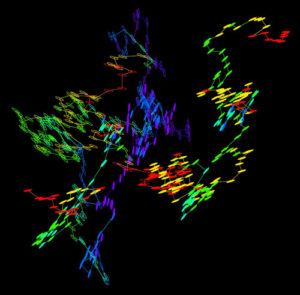
Brownian Motion
Albert Einstein ever the watcher of interesting puzzles and problems in various fields of endeavor happened upon a problem proposed by Robert Brown (1905) who had observed seemingly random motion of spores in a container of water. At the time there did indeed exist a rough qualitative description of this random motion being attributable to the action of molecules bumping up against the spores in the water. However, it was only until 1905 that Dr. Einstein provided a detailed theoretical analysis of the situation that would readily explain what was being viewed. His explanation offered an ability to statistically predict particle motion which were readily proven experimentally.
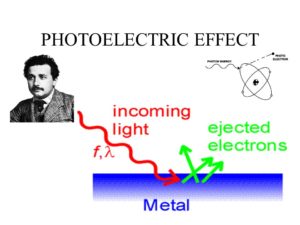
Photoelectric Effect
For those that don’t know, the photoelectric effect (1905) was the creative invention that won Dr. Einstein the Nobel Prize in 1921; he never specifically won this award for General or Special Relativity although his theoretical contributions were noted for these theories. For some time it had been observed that when light struck an object such as a metallic material electrons were emitted therefrom. One problem with this observation was that as the intensity of light was increased the number of electrons correspondingly increased, however, their energy did not correspondingly increase.
The current model in vogue at the time, taught that the electron’s emission energy should vary according to the amount of inputted energy. The inability to detect an energetic increase in the emitted electron stream required a response and Einstein rose to the occasion. He theorized that light can be considered as being made up of particulate having energy in proportion to the frequency of the light radiation. Thus, as the light struck an object the electrons emitted would necessarily have a quanta of energy corresponding to impacting light photons. In one stroke of his pen, Einstein had overturned a long held view that light is composed on waves. Now light was shown to have a dual nature having both wave and particle characteristics. This theory of quanta was shown to be true some years later by experimental observation of Robert Millikan.
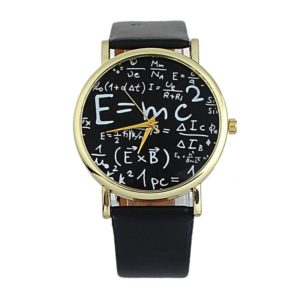
Special Theory of Relativity
In 1905, Einstein also provided an explanation as to the null result of the Michelson Morley Experiment. Since the time of Galileo (and even further back), inertial frames of reference were believed to be relative to an absolute or immovable frame as Isaac Newton also believed. However, results from the Michelson Morley experiment failed to detect the aether. Scientists for some time theorized the existence of the aether as ordinary observations of physical phenomenon required a propagating medium for light. Waves move on water, air or through the Earth (seismic waves) are some common examples. Thus, according to theory, light required a propagating medium which was believe to be the ‘luminiferous aether.
However, Michelson Morley failed to detect one. A possible explanation of this null result was provided by Fitzgerald and Lorentz in their now famous contraction hypothesis such that the null result was due to length contraction and and a resulting time dilation that was thereby codified in the Lorentz Transformation Equations. Einstein would seize upon these ideas and provided a comprehensive theoretical explanation by providing two fundamental postulates: the principle of relativity indicating that the laws of physics are the same in all frames of reference and secondly the constancy of the speed of light in a vacuum for all inertial observers. The Lorentz Transformation Equations were thereby manipulated to show the equivalence of mass and energy in the famous expression: E=mc^2 .
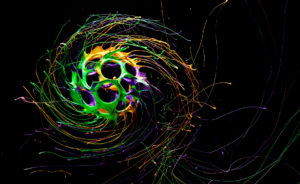
General Theory of Relativity
Albert Einstein later provided a generalized explanation of his special theory of relativity applying the principles of the aforementioned as far as practical to the case of frames of reference that are accelerated. Thus was born (1916) the general theory of relativity that described the effect of gravitation on space implying a curvature of space near mass concentrations. The effect of this curved space was shown to be true during observations of light arriving from distant stars. Light passing a massive body is deflected by its intense gravity field. This effect was first shown observationally by Sir Arthur Eddington in 1919. However, a dispute about the effectiveness of the results required further tests to be performed. These were carried out in 1922 by Lick Observatory astronomers, 1953 by Yerkes Observatory astronomers and in 1973 by University of Texas astronomers. All of these pointed to a positive affirmation of the theoretical system.
Other effects such as gravity lensing and light redshift have similarly shown to accurate according to the interpretations given to the mathematical theory. Thus, the phenomenon known as gravitational lensing indicated that light from distant stars can be distorted to show multiple images.
Bose Einstein Condensate
1924